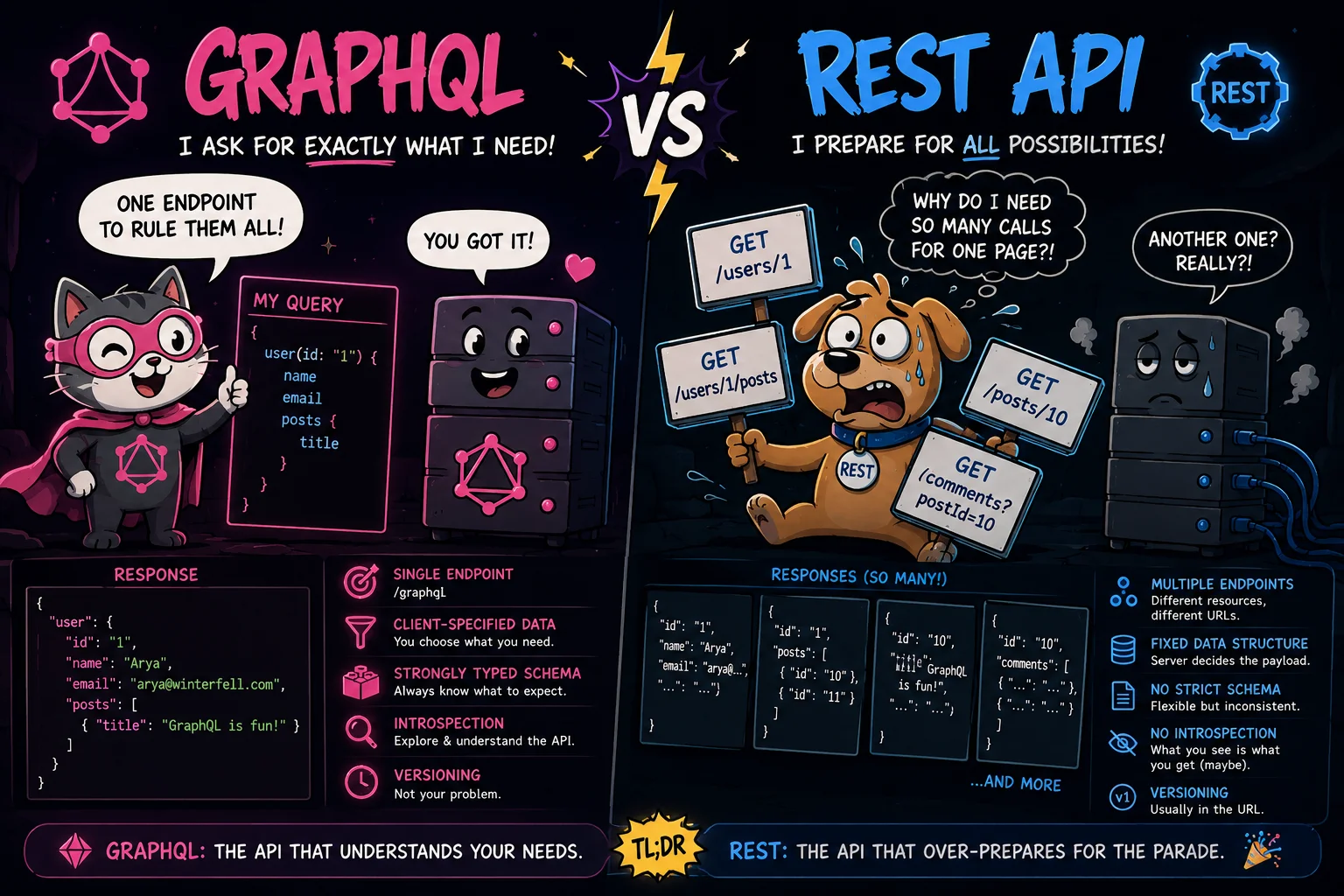
A few years ago, the tech world decided that GraphQL was going to entirely replace REST. We were told it was the silver bullet for over-fetching, under-fetching, and frontend developer experience. Now that it is 2026, the dust has settled, and the hype cycle has given way to architectural reality.
When architecting solutions for clients, the conversation should rarely start with "Which technology is inherently better?" Instead, it should start with a much more pragmatic question: "Which set of trade-offs are we willing to pay for?"
Here is a hype-free evaluation of when to adopt GraphQL, and when standard REST remains the superior choice.
The Allure of GraphQL (Where it Shines)
GraphQL was built to solve specific, painful problems associated with highly complex client interfaces.
If your application features deeply nested, highly relational data, GraphQL feels like magic. Instead of hitting four different REST endpoints to load a user profile, their recent posts, the comments on those posts, and the authors of those comments, the client dictates exactly what it needs in a single query.
This client-side flexibility is incredible for:
- Mobile Applications: Where minimizing network requests and reducing payload sizes is critical for users on poor connections.
- Rapid UI Iteration: Frontend teams can build new views requiring different data shapes without needing backend engineers to spin up bespoke endpoints.
The Hidden Taxes of GraphQL
The flexibility of GraphQL is not free. You are simply shifting complexity from the client to the server. Before adopting it, you must be prepared to pay the "GraphQL Tax."
1. The Caching Problem
REST leverages standard HTTP semantics. A GET request to /api/users/123 can be effortlessly cached at the edge by a CDN, by the browser, or by your proxy. GraphQL, however, typically funnels everything through a single POST endpoint (/graphql). Because every query is unique, HTTP-level caching becomes effectively useless. You are forced to implement complex, application-level caching strategies (like persisted queries or normalized client caches).
2. The N+1 Query Nightmare Because GraphQL resolves fields individually, a poorly optimized server can easily trigger hundreds of database queries to fulfill a single, deeply nested client request. Solving this requires implementing tools like DataLoader to batch and cache database calls within a single request tick. This is an overhead you rarely worry about with standard SQL joins in a REST endpoint.
3. Security and Rate Limiting How do you rate-limit a single endpoint where one query might ask for a user's name, and another might ask for 10,000 records of historical data? You have to calculate query complexity and depth before execution, which requires specialized tooling and strict architectural boundaries.
The Enduring Case for REST
For the vast majority of web applications, REST remains the gold standard.
The predictability of standard HTTP methods (GET, POST, PUT, DELETE) means that the tooling ecosystem is infinitely mature. Monitoring, logging, caching, and rate-limiting are solved problems at the infrastructure level.
Furthermore, the barrier to entry is virtually zero. You can spin up a RESTful API in minutes with almost any modern web framework, and any frontend developer instantly understands how to interact with it. If your domain model is relatively flat, and your client views generally map 1:1 with your database entities, GraphQL introduces massive overhead for very little reward.
How to Decide
When choosing your API architecture, ask these three questions:
- Who is consuming the API? If it is a single, internal web application where the frontend and backend teams work closely together, REST is usually faster and cheaper. If you are building a public API for third-party developers, or serving multiple diverse clients (Web, iOS, Android), GraphQL's strong typing and single-request payloads start to pay off.
- How complex is your data graph? Flat, resource-driven data favors REST. Highly interconnected, relational data favors GraphQL.
- Do you have the backend maturity? Adopting GraphQL means taking on query complexity analysis, N+1 optimization, and bespoke caching. If your team does not have the bandwidth to maintain that infrastructure, it might be best to stick to REST.
There are no silver bullets in software engineering. GraphQL is a powerful tool for a specific set of architectural challenges, but REST is still the workhorse of the web for a reason. Choose the one that fits your team, not the one that fits the trend.