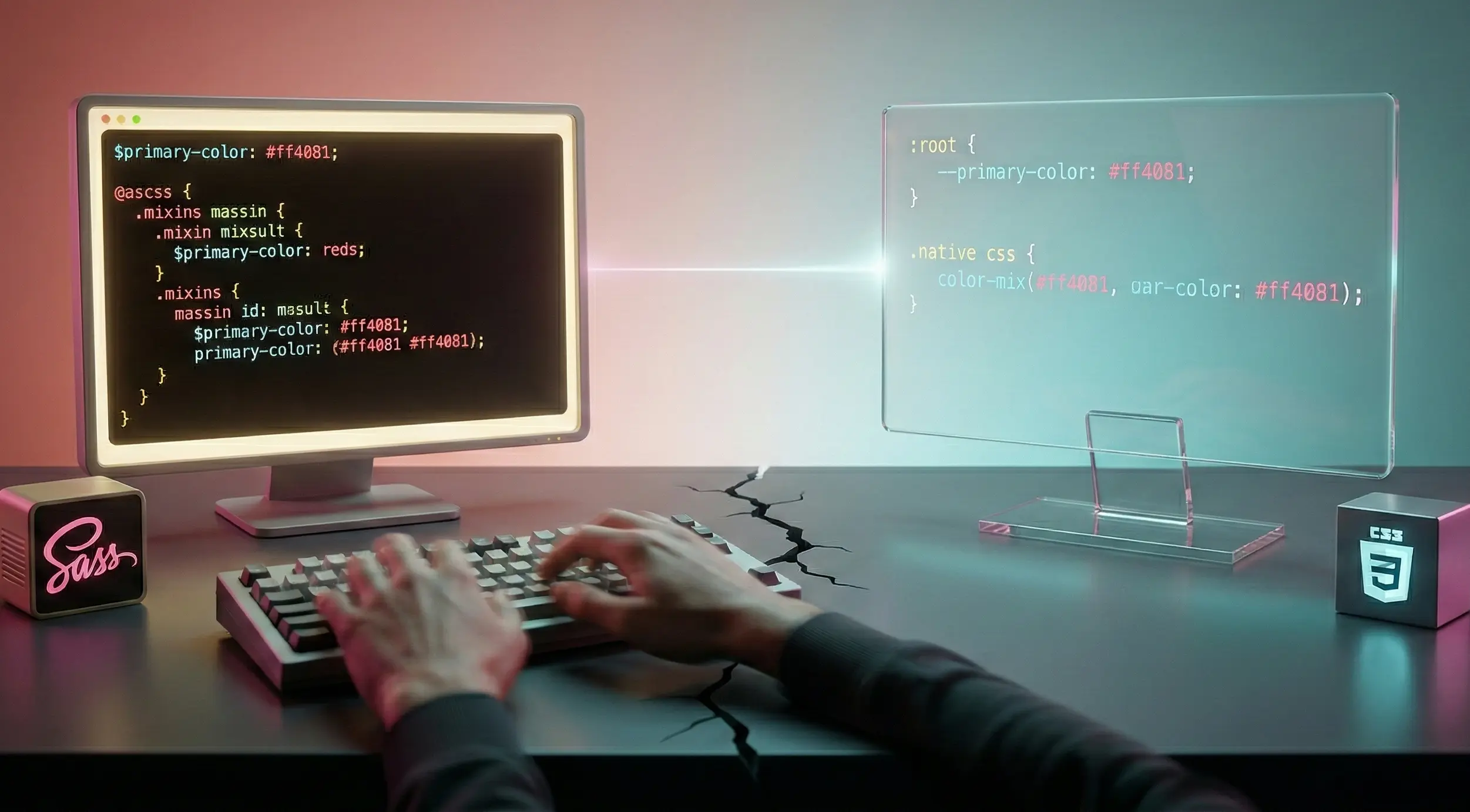
I still remember the first time I used SASS. It felt like a superpower.
For years, writing CSS was an exercise in repetition. We drowned in "callback hell," copy-pasting hex codes across dozens of files, and fighting global scope with naming conventions that felt more like band-aids than architecture. Then SASS arrived. It didn't just add features. It gave CSS a programming structure. It gave us variables, logic, loops, and the ability to breathe.
I have been a SASS advocate for a long time. It has been the backbone of almost every design system I’ve built. But recently I’ve found myself asking a question that would have been blasphemy a few years ago: Is it time to let it go?
With the rapid evolution of native CSS and the paradigm shift brought by utility-first frameworks like TailwindCSS, the line between "essential tool" and "unnecessary friction" is blurring.
The Native CSS Renaissance
The primary argument for SASS was always that it did things CSS simply couldn't. That argument is dissolving before our eyes. The W3C has been on a tear, shipping features that directly replace the core functionality of pre-processors. In many cases, they are doing it better because they run in the browser rather than the build step.
Visualizing the Shift
To see how much has changed, let's look at a common pattern: defining a brand color and darkening it on hover.
The SASS Way: With SASS, we needed a pre-processor to handle variables and color math.
$brand-color: #007bff;

.button {
  background-color: $brand-color;
  &:hover {
    /* "darken" is a SASS-specific function calculated at build time */
    background-color: darken($brand-color, 10%);
  }
}
The Native CSS Way: Today, the browser handles this natively. We gain the benefit of dynamic variables that can be updated by JavaScript or media queries.
:root {
  --brand-color: #007bff;
}

.button {
  background-color: var(--brand-color);
}

/* No pre-processor needed for scope or nesting */
.button:hover {
   /* Using color-mix for dynamic darkening in the browser */
  background-color: color-mix(in srgb, var(--brand-color), black 10%);
}
1. Variables vs. Custom Properties
SASS variables ($primary-color) were great, but they died at compile time. Once the browser saw them, they were just static hex codes.
Native CSS Custom Properties (--primary-color) are alive. They respect the cascade, they can be manipulated by JavaScript, and they are context-aware. You can change a theme from light to dark by flipping a single class on the <body>, and every variable updates instantly. SASS literally cannot do this.
2. Nesting is Native
For years, the killer feature of SASS for me was nesting. It saved me from typing .nav .nav-item .nav-link a thousand times.
Today, native CSS nesting is here, and the syntax is very similar to SASS. If the browser understands this natively, why add a build step to transpile it?
3. Color Functions
We used to rely on SASS for lighten() and darken() to generate hover states. Now we have color-mix() and oklch(). Not only do these run natively, but they also offer perceptually uniform color spaces that SASS’s math-based color functions often struggled with. No more muddy grays when you just wanted a lighter blue.
The Tailwind Factor
It is impossible to talk about the decline of SASS without talking about Tailwind CSS.
The industry has largely shifted away from "Semantic CSS" (writing custom classes like .sidebar-widget-title) toward "Utility CSS" (writing text-lg font-bold p-4).
When you use Tailwind, you stop writing CSS files almost entirely. You aren't creating BEM structures, you aren't managing deep inheritance trees, and you certainly don't need SASS mixins to generate vendor prefixes. The utility framework handles the complexity. In a Tailwind project, SASS becomes a heavy tool used for a problem that no longer exists.
Where SASS Still Wins in 2026
Does this mean SASS is dead? No. There are still valid use cases where a pre-processor shines, particularly in complex architecture:
Complex Loops: Native CSS cannot yet loop through a list of values to generate utility classes (e.g., @each $color in $colors). If you are building a framework rather than using one, SASS is still king.
The Ecosystem: If you are working with Bootstrap or Carbon Design System, you are working with SASS. The legacy ecosystem is massive.
Heavy Math: Sometimes you want calculations done at build-time to save the browser from doing the work every time the page paints.
The Verdict
If I were starting a greenfield project today, would I reach for SASS by default? Probably not.
Between the power of modern native CSS and the efficiency of PostCSS plugins for the remaining gaps, the "standard" stack has changed. We are moving from a world where we needed a chaperone to write CSS to a world where the browser is finally the grown-up we always wanted it to be.
It isn't a bitter breakup. It is a graduation. SASS served us incredibly well, but sometimes the best way to honor a tool is to acknowledge when you no longer need it.